Pascal / Research & Science
Give research teams more capacity to investigate.
Connect literature, experimental records, data, and scientific tools. Agents can help investigate a question, run analyses, and build tools for the team to review.
For research organizations, scientists, and engineering teams

Product walkthrough. Press Space or Enter to pause or play.
Bring the research environment into the investigation.
A research question can cross literature, experimental records, datasets, and scientific software. Connect those sources so agents can help investigate, write analysis code, and return findings for the team to assess.
Three questions, from source review to the next experiment.
Start with a question and the sources and tools it requires. Use Tasks to organize the investigation, Compute to run analyses, and Work Surfaces to build interactive tools.
The examples follow investigations in chemistry, electrical engineering, and climate science. Their molecular viewer, circuit explorer, and coastal map help a researcher inspect the analysis and plan the next experiment.
- 01
Delegate an investigation. Keep the evidence in view.
Give agents a consequential question and the context to pursue it. They can divide the work, reconcile papers with experimental records, interrogate structured data, and follow the evidence when it changes the hypothesis. In this electrolyte investigation, transport and interface results disagree. Agents surface the contradiction, compare formulations, and build a molecular explorer to support the next experimental decision.
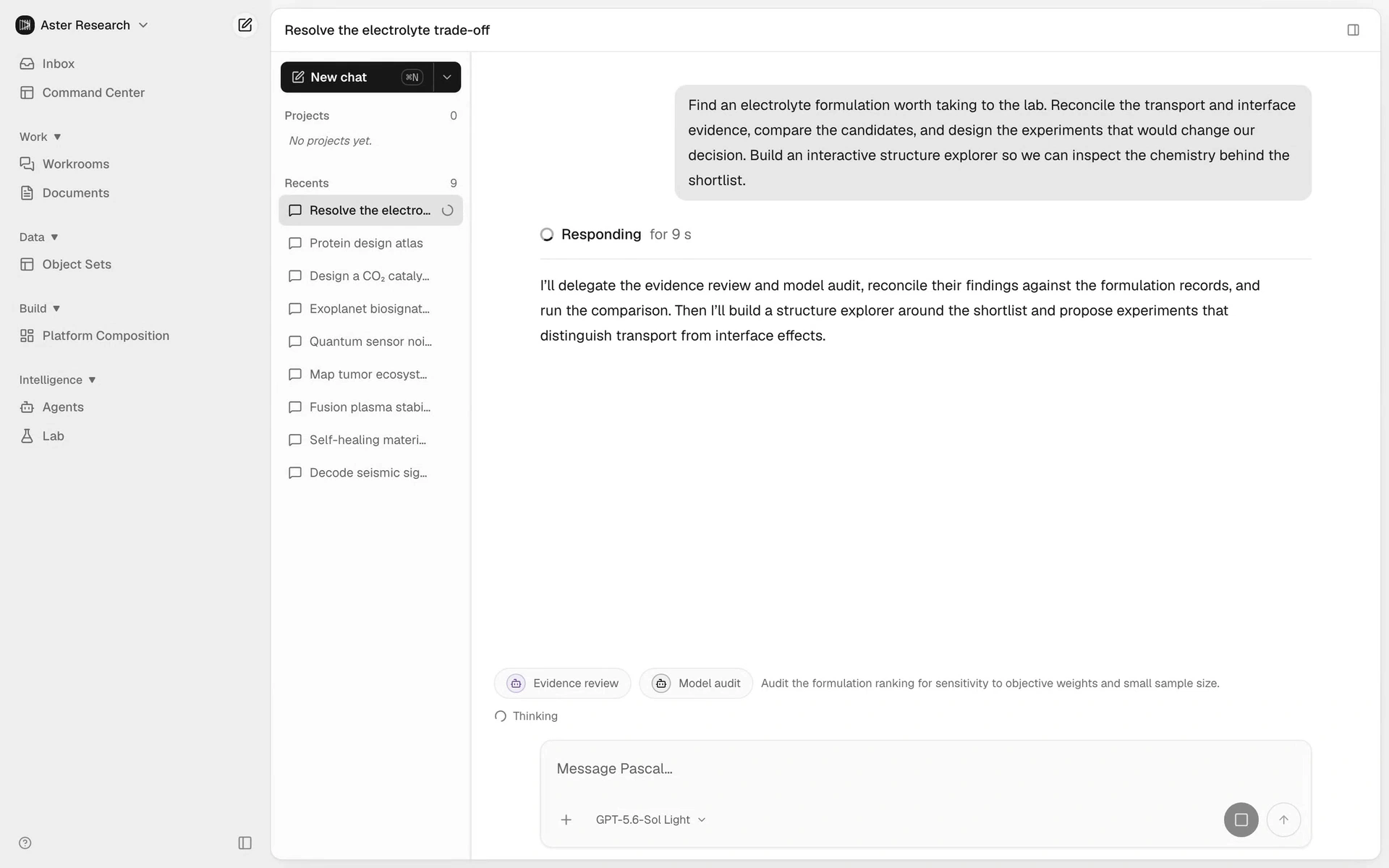
Product walkthrough. Press Space or Enter to pause or play.
- 02
Run the analysis. Build what the question needs.
Research rarely stops at a written answer. Agents can write analysis code, run computation, test assumptions, and turn useful methods into interactive tools inside the investigation. Here, a sensor resonance becomes a transfer-function analysis, a 23,088-response tolerance sweep, and an agent-created circuit explorer. The model, its limitations, and the proposed bench test remain connected.
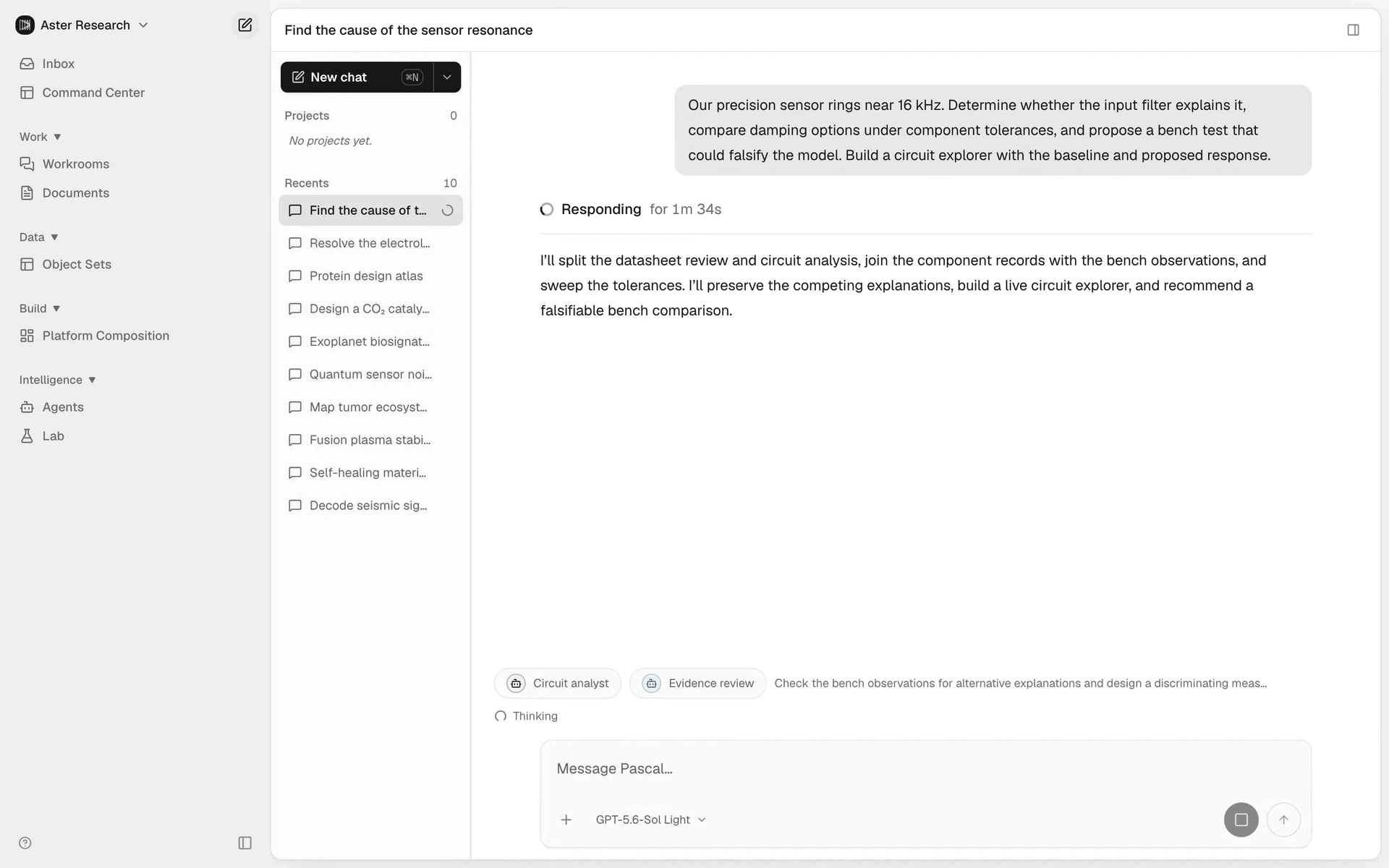
Product walkthrough. Press Space or Enter to pause or play.
- 03
Turn findings into the next research decision.
Bring the sources, analysis, software, and collaborators into a shared research record. Review what the evidence establishes, what remains uncertain, and which next step would teach you the most. In this coastal study, agents audit observation coverage, compare two hypotheses across 336 site-time pairs, and build a map explorer for planning a discriminating transect. The result is a research plan the team can inspect and continue.
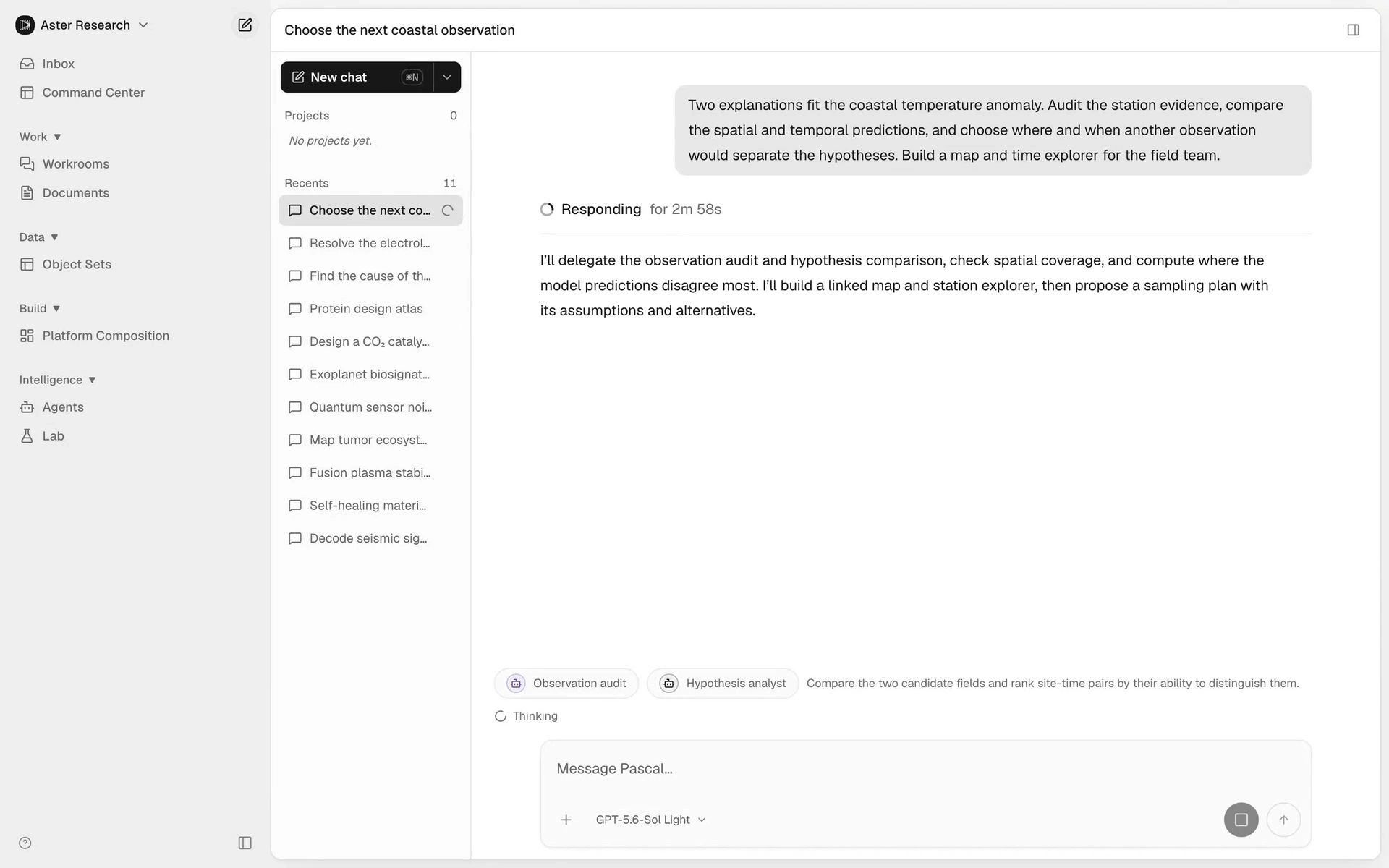
Product walkthrough. Press Space or Enter to pause or play.


A record the research team can challenge and continue.
Each investigation brings together sources, code, assumptions, and an interactive tool. The team can inspect the analysis, challenge the interpretation, and decide what experiment to run next.
Evaluate the investigation against its question.
Define a useful scientific result before the first investigation. Use these measures to evaluate progress with your team.
More questions pursued deeply
Extend the team’s capacity for evidence review, analysis, and hypothesis testing across a research program.
Measure Research objectives advanced to an inspectable result
A shorter path to the decisive experiment
Use computation and competing explanations to focus scarce laboratory, bench, and field time.
Measure Time from a research question to a useful experimental decision
Research that compounds
Retain sources, methods, code, and useful applications so the next investigation starts with more context.
Measure Methods and research outputs reused by the team
Keep the research inspectable.
Scientists review conclusions and authorize laboratory, bench, and field work. Molecular structures retain their published PubChem identities.
Explore governanceReuse the methods in the next investigation.
Carry useful sources, code, and methods into the next question. Agree on its assumptions and review requirements before reusing an earlier result.
01
Set the research objective
Define the question, constraints, and decision the investigation should inform.
02
Delegate the investigation
Agents pursue complementary lines of inquiry across connected evidence and data.
03
Test the hypotheses
Write analysis code, run computation, inspect counterevidence, and compare alternatives.
04
Build the missing tool
Turn useful analysis into an interactive explorer or scientific application within the research environment.
05
Advance the research program
Review the result, choose the next experiment, and continue with the sources and methods retained.
Discuss a research question.
Bring a research question, relevant records, and the tools your team uses. We’ll discuss what agents could investigate and how your team would assess the result.
- Connect the research environment
- Bring your knowledge, datasets, code, scientific tools, and access boundaries into a coherent workspace.
- Delegate consequential work
- Give agents a real investigation, an explicit objective, and room to follow the evidence.
- Build a repeatable research capability
- Review results, retain methods and context, and extend the work into the next investigation.